Their own edition, every week
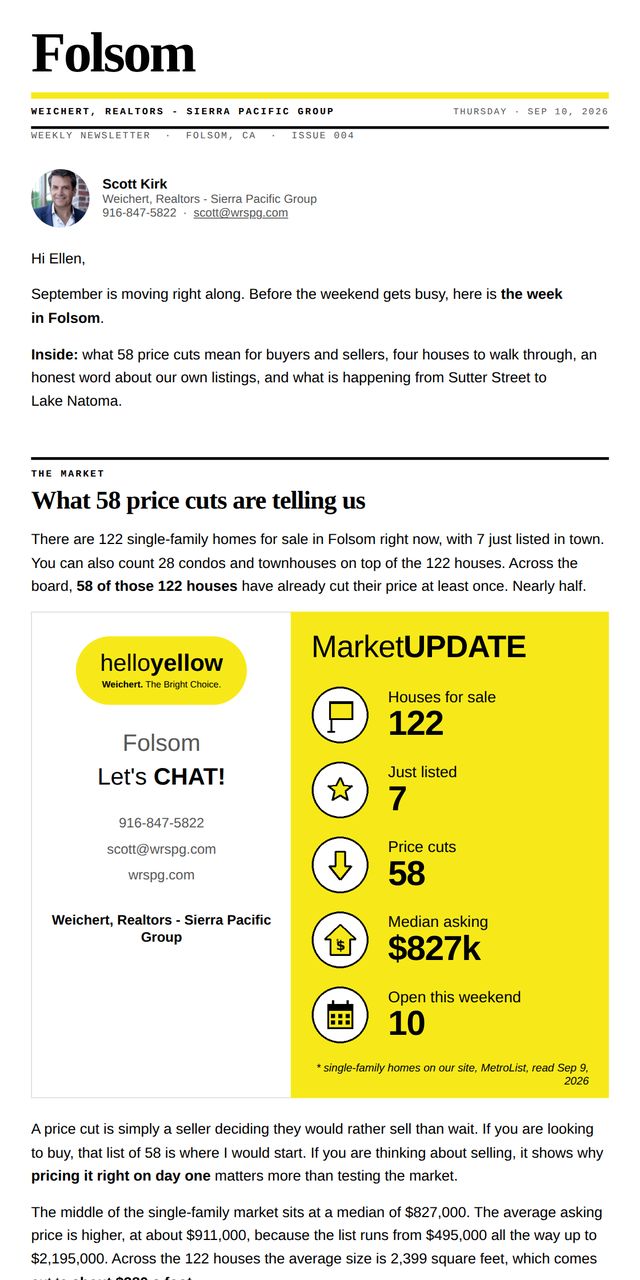
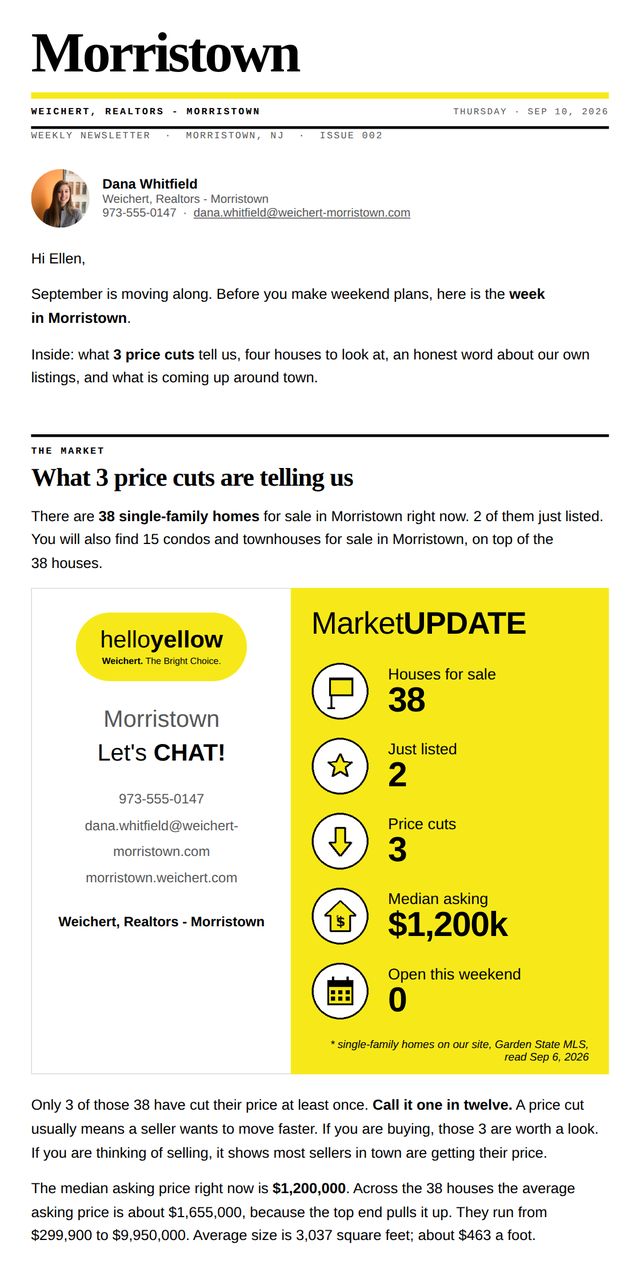
Their name, their photo, their phone and email on a newsletter about the town they work, sent from their own BoldTrail account to their own sphere. The reader sees the agent, not Bureau.
Every number in both is checked before it ships, and you get the ledger. Nothing to install: one template in the BoldTrail you already have. We have put 81 episodes on Apple Podcasts for our own office in Folsom since 2025.
Every agent gets the week's issue as their own edition: their name, their photo, their contact block, going to their own sphere. It's opt-in: an agent who doesn't want it doesn't pay and doesn't get an edition. We charge each agent's card once a month, keep a processing cut, and send the rest to your bank account by the 15th. You never collect a thing. Put your own agent count in, guess how many will say yes, and see where you land.
$19 a week is billed as $82.33 a month, $988 an agent a year. $9.50 a week is $41.17 a month, $494 a year. One card charge per agent per month. Bureau keeps 6% of each charge or $3.00, whichever is more, to cover card processing; on the $9.50 plan that is the $3.00 minimum. The rest goes to the brokerage's bank account by the 15th of the following month. Bureau is $1,000 a month, or $11,000 paid a year ahead, plus a one-time $2,000 to set the first market up, which covers 50 agents; $25 an agent beyond that. No other charges.
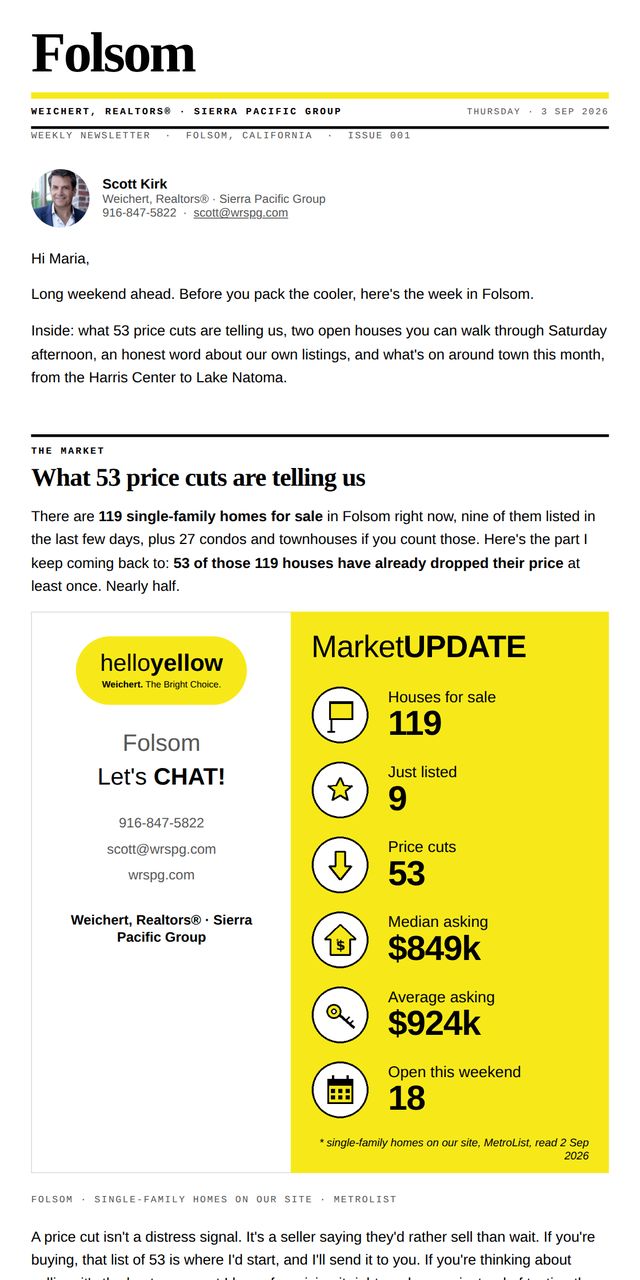
Their name, their photo, their phone and email on a newsletter about the town they work, sent from their own BoldTrail account to their own sphere. The reader sees the agent, not Bureau.
A reason to be in the inbox every week without writing a word: the market, this weekend's open houses, what's on in town, and a show they can share. Every reply comes to them.
The figures are read off the office site, every claim is graded against its source, and the broker approves the issue before it ships. The agent's license is not on the line for a number nobody measured. Opt out any month.
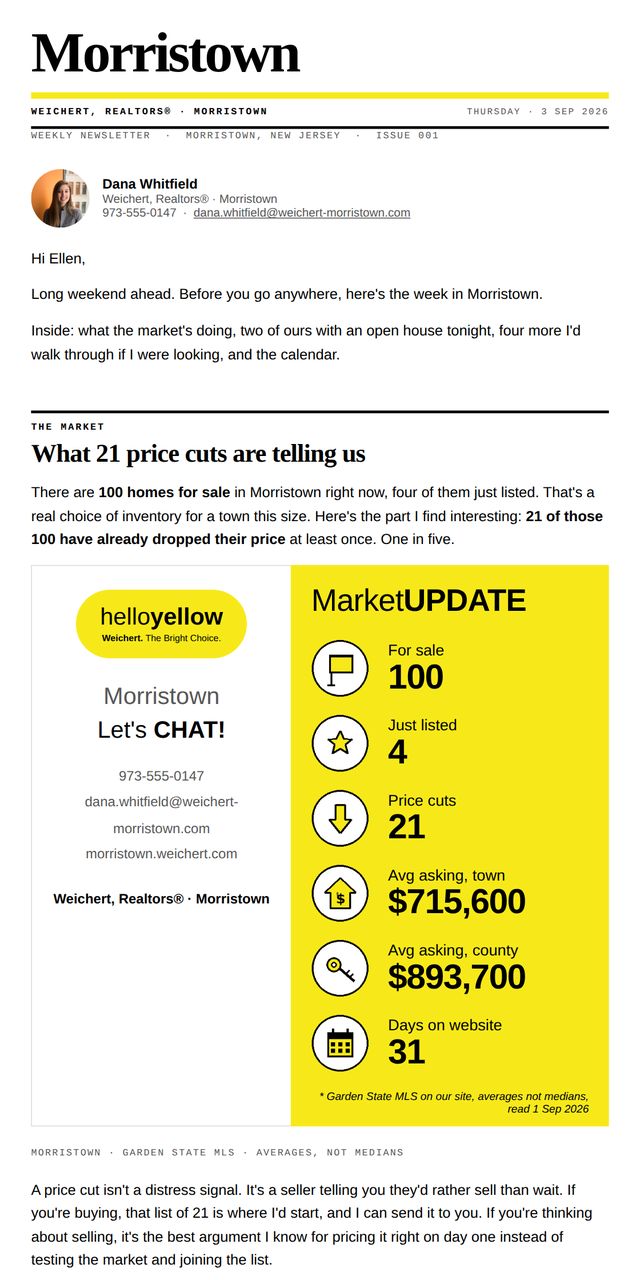
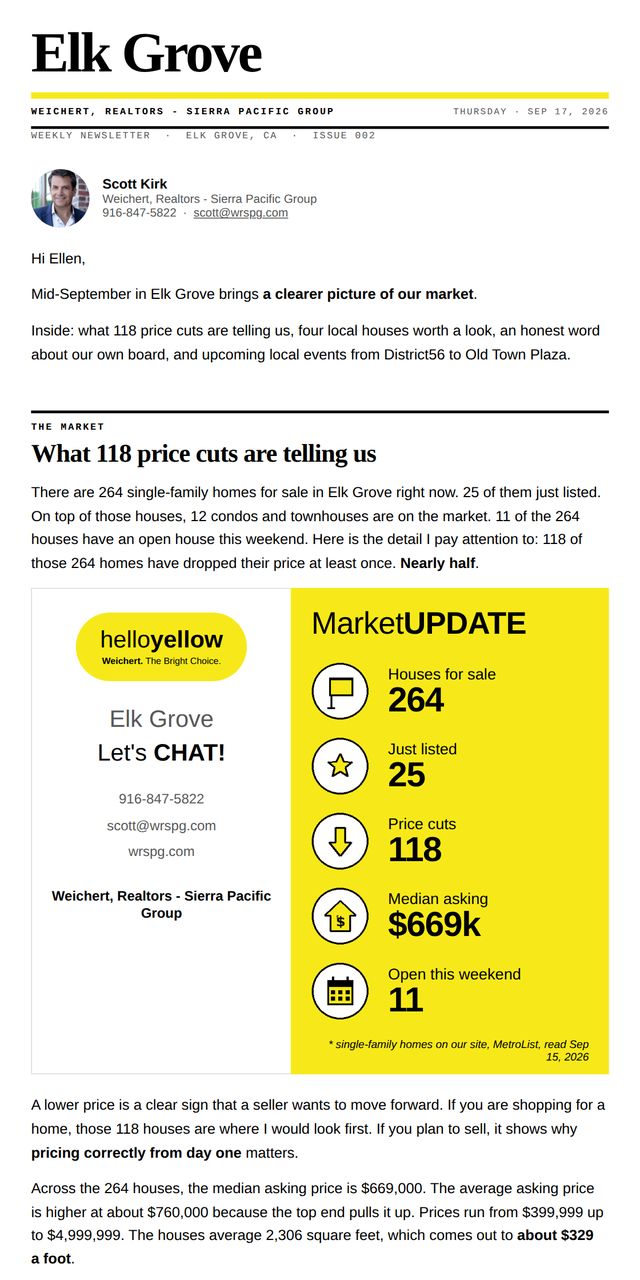
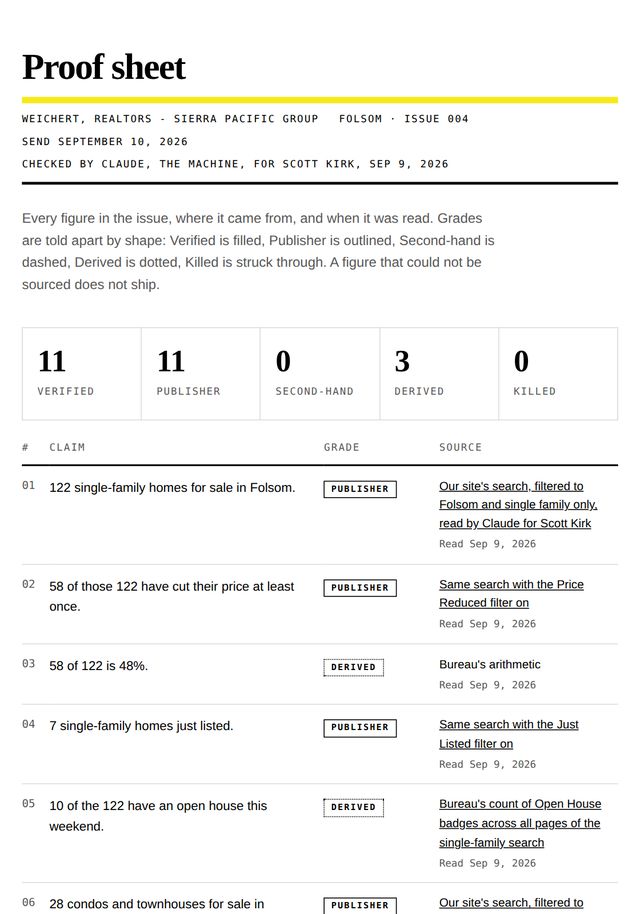
Two pieces a week, same facts in both, and a ledger for you. Below: this week's Morristown and Folsom issues as the machine built them, then two hand-built samples from the first week of September. All of them are dated: the figures are what the sites showed that week.
What's happening in town, what the market numbers mean there, your listings, and the week's events, written as the agent to a neighbor. Nothing in it that a reader shouldn't see; the sources are on the proof sheet. Each agent gets it as their own edition: their name, their photo, their sphere. The sample issues use asking prices only, because that is what a BoldTrail site publishes; sold figures come in once your feed carries them, and until then the issue says which side of the market it is describing.
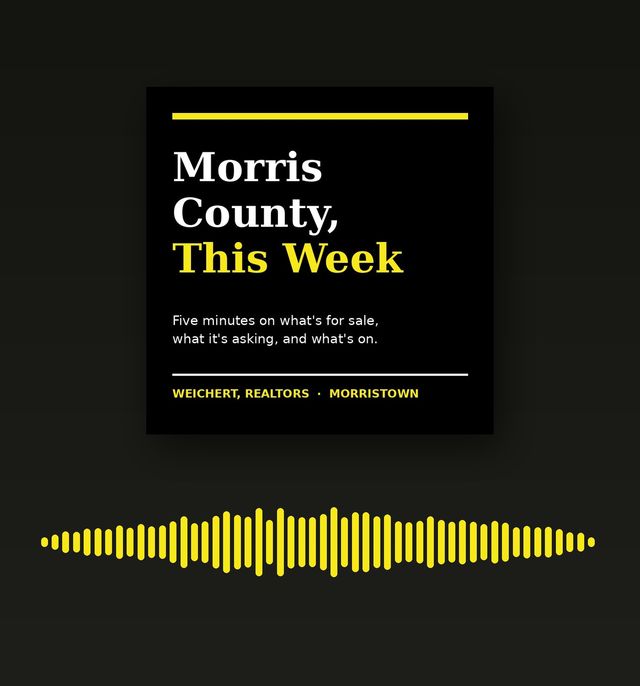
The same week, in three to seven minutes. Written off the same checked notes, so what people hear can't drift from what they read. The voices are synthetic and we say so; the script is checked the same way the issue is, and the recording is transcribed and compared to the script before it goes anywhere.
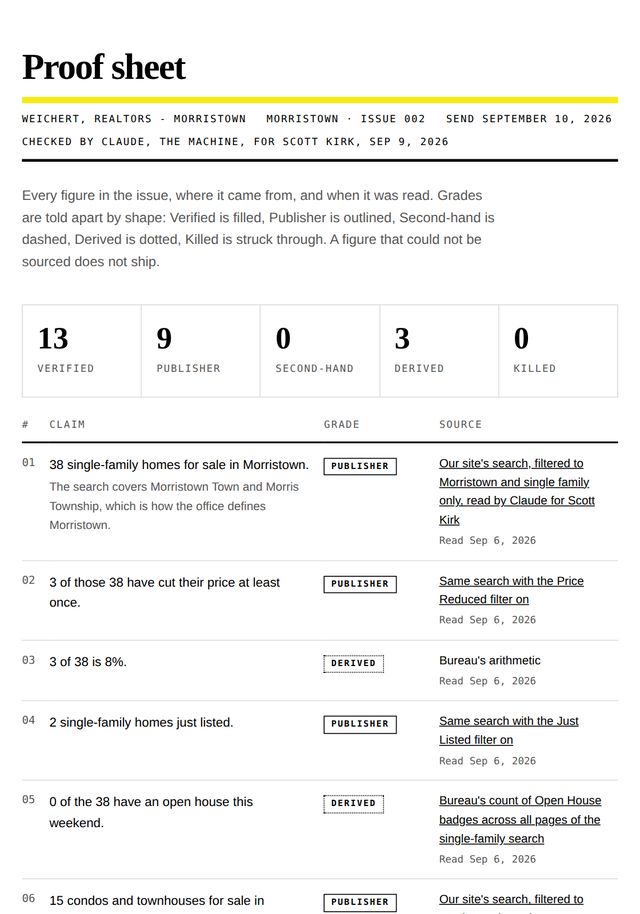
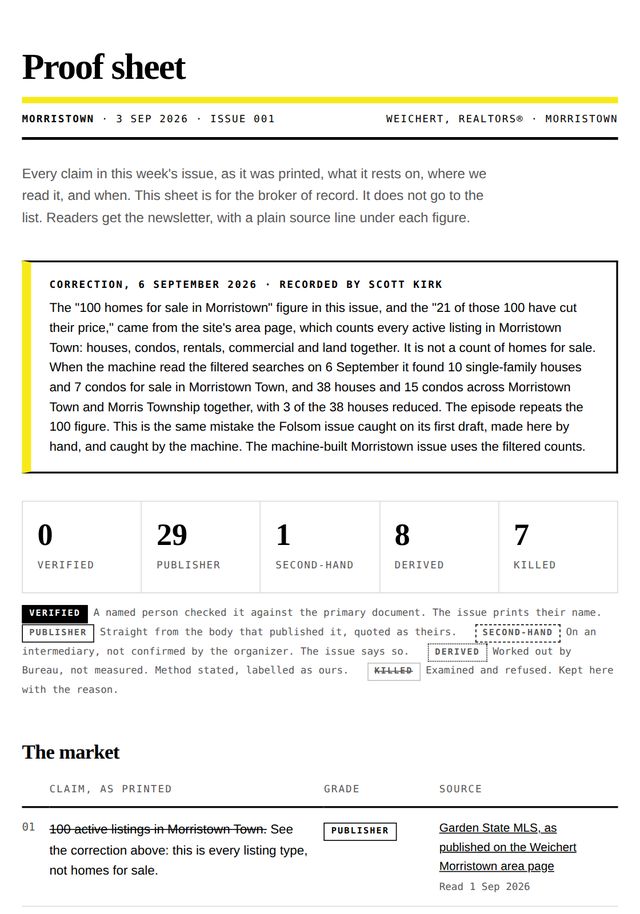
Readers get a clean issue with the MLS attribution your board requires and nothing else. You get the full ledger on a separate proof sheet: every claim, what it rests on, when it was read, how well it's known, and who approved the issue, with the time.
The same machine, pointed at New Jersey. Figures read off the Morristown office site on 6 September, in the two areas that office's own search covers, Morristown Town and Morris Township; the issue says so. Fourteen events found by a research assistant, one pulled by the broker,, each one verified by the machine against the organizer's own page and signed in the machine's name. The Garden State MLS cards on that site do not name the listing office, so the issue does not invent one. Proofed to the broker of record, revised at his request several times, each one on the record, and approved by him on 9 September against a fingerprint of the exact text. The episode is cut after approval; the 3 September episode below shows the form. The record is on the proof sheet.
A new market, from nothing to a scheduled issue and a five minute episode in one afternoon. Figures read off the office site on 15 September, eleven events verified against the organizers' own pages, twenty-six claims graded, proofed to the broker of record and approved by him the same day. Then the machine wrote the episode from those twenty-six claims and nothing else, read it in two voices, transcribed the recording and checked it back against the script.
Rebuilt on 9 September with that day's figures, after the broker asked for the office's own listings to run even when they are outside town. Figures read off the office site, eleven events verified against the organizers' own pages, copy written from the checked facts and every number checked back. Proofed to the broker of record and approved by him on 9 September. The issue before it, approved on 5 September and corrected on the record, is still on the 5 September proof sheet.
Type your name and the sample issue is rebuilt as your edition, the way your agents' editions go out: your name, your contact block, your office on the masthead, every reply to you. The figures and the proof sheet stay exactly as they are.
Publishing every week is the hard part. Getting it right is the job.
Any tool will generate a market update in thirty seconds, and any of them will eventually print a number nobody measured. Under your license, you own it. Bureau grades every claim before it ships, keeps the ones it refused, and hands you the ledger. Five marks, told apart by shape, not color, so a black-and-white printout still works.
Somebody opened the source, checked it, and put their name on it. A person, or the machine in its own name. The issue prints the name.
Straight from whoever published it. The city, the MLS, the organizer.
On a calendar but not confirmed. Runs as a save-the-date and says so.
Worked out, not measured. The issue says so in plain words.
Thrown out before send, then printed on the proof sheet anyway with a line through it and the reason.
The Morristown episode was first produced the easy way: hand an AI the checked figures and let it talk. Seven takes over two days, each transcribed and read line by line against the figure pack. One was accurate and dull; the rest got a number wrong or made something up. So the episode was written instead, from the same figures, in the shape of the broker's own show, and read by two synthetic voices. Then the recording was transcribed and compared to the script word for word.
The script is printed on the episode page under the player; the seven takes are on the Morristown proof sheet, struck through, with what killed each one.
Starting a brokerage newsletter is easy. Two people write the first one and it's good. Then a listing blows up in week three, somebody's on vacation in week six, and by spring there's a podcast feed with four episodes on it and a date nobody wants a client to see.
81 episodes produced for Weichert, Realtors - Sierra Pacific Group, Scott Kirk's own office · one Sacramento town each · counted off the Apple Podcasts listing, 30 Aug 2026
That's the whole pitch. Not that we write better than your agents do. That it goes out when your agents are busy.
Some won't, and they don't have to. It's opt-in. Each agent sees their own edition before saying yes. At 40 agents, 13 paying is break-even; below that it costs you, and you can cancel any month. The agent who pays $82 a month gets a Thursday in every inbox in their sphere without writing a word.
The cards are the same cards your BoldTrail site already shows and emails, linked back to your site, with the listing office named where the feed names it. Where your board's IDX rules say no cards in email, we drop the cards and keep the counts. Your board's attribution and disclaimers are in the template, not left to the agent.
You do, under your license. That is why every figure is quoted as the MLS's with the date it was read, why the machine signs its check in its own name, and why you approve before it sends. When something is wrong after the send, the correction goes on the record in the open. Two are on this site.
Your choice, set once in your settings. Either it goes out as proofed and the record says the clock approved it, or it holds until someone in your office approves. The default is send, because a Thursday with nothing is the failure this exists to prevent.
No. Two synthetic voices reading a script written from the checked claims, and the episode says so. The recording is transcribed and compared to the script before it goes anywhere. Seven improvised takes were killed before the first episode shipped; they are on the proof sheet.
Your office website address and one town. That gets you the free draft and its proof sheet. To go live: a BoldTrail login to load the template, your board's disclaimer text, and your agents' names and photos, which BoldTrail already has.
Split it. A market is one town or one named part of a big one, the way your office already splits it. Up to four markets are in the price; most offices use two or three.
No. Month to month, cancel any month, no notice period, and you keep every issue, proof sheet and record as a file you can download. Pay a year ahead and the twelfth month is free.
One issue a week for each market you name, up to four, and one episode a week that covers all of them. Month to month, cancel any month. Pay a year ahead and the twelfth month is free.
A market is one town, or one named part of a big one. Morristown is a market. Newark is several, split the way your office already splits it. Four markets is most offices; if you need a fifth, ask.
The draft is free either way. Check it the way you'd check anything with your name on it. If it holds up, we start your first month.

Scott Kirk is broker and owner of Weichert, Realtors - Sierra Pacific Group in Folsom, California, licensed since 2009 with more than 500 closed transactions, and Weichert's western region representative for national marketing. Bureau of Record started as the newsletter and show his own office sends.